


Cane Carrying, Cane Stepping, and Strolling in Kappa Alpha Psi: A Historical Clarification Grounded in Official Records and Alumni Memory
- Marcus D. Taylor

- Jan 9
- 5 min read

Introduction
Few symbols within Black Greek Letter Organization culture are as recognizable as the cane associated with Kappa Alpha Psi. Over time, however, the historical distinctions between cane carrying, cane stepping (often described as cane twirling), and strolling have become blurred. Modern performances, social media circulation, and generational storytelling have compressed these practices into a single assumed tradition. Historically, they are not the same.
This article offers a documented historical clarification, drawing directly from The Story of Kappa Alpha Psi (6th ed., 2023) and supported by cultural scholarship and alumni oral history. Its purpose is not to prescribe present-day performance practices or elevate one expression above another, but to clarify how these traditions developed, overlapped, and were later interpreted. Historical accuracy strengthens tradition by preserving context, meaning, and lineage.
Methodological Statement
Kappa Alpha Psi has not issued a constitutional or ritual definition formally separating cane carrying, cane stepping, or strolling. In the December 1985 edition of the Journal was the first time the "Yo" and canes were on the cover.
Accordingly, this analysis synthesizes information from:
The Story of Kappa Alpha Psi (6th ed., 2023), the fraternity’s most recent officially published historical text
Documented leadership observations contained in Chapter 21 & 23 of that work
Cultural scholarship on stepping
Alumni recollections offered as oral history
Official fraternity records are treated as authoritative where they provide documentation. Alumni recollections are presented as experiential accounts reflecting campus-level practice rather than comprehensive fraternity-wide mandates.
The Cane as Symbol Prior to Performance
Official fraternity history explicitly clarifies that cane carrying was not connected to the founding of Kappa Alpha Psi, nor was it originally associated with choreographed movement or competitive performance. The historical record indicates there is no documentation of members using canes as performance props prior to the mid- to late-1960s (Kappa Alpha Psi Fraternity, Inc., 2023).
Early cane use functioned as symbolic representation, reinforcing ideals of discipline, composure, and gentlemanly presentation rather than expressive movement. This distinction is foundational to understanding the later development of cane-based performance practices.
Earliest Documented Cane Carrying
Although canes were not initially used in performance settings, official records document their symbolic presence earlier than commonly assumed. Photographs of Scrollers and probate presentations featuring canes begin appearing in school yearbooks and in The Kappa Alpha Psi Journal during the early 1950s.
The earliest documented instance of Scrollers carrying canes as a visual prop dates to December 13, 1948, associated with the Gamma Theta Chapter at Bethune–Cookman University (Kappa Alpha Psi Fraternity, Inc., 2023). These appearances were representational rather than choreographed, confirming that symbolic cane carrying preceded performance usage by more than a decade.
The Advent of Cane Stepping (Mid- to Late-1960s)
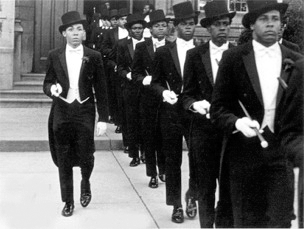
According to the fraternity’s official history, canes did not begin appearing as props in organized routines until the mid- to late-1960s, coinciding with the increased prominence of step shows and competitive campus programming. During this period, canes entered structured performances, marking the emergence of cane stepping.
Early cane stepping emphasized:
Upright posture
Controlled, precise movement
Emphasis on cane manipulation
Limited or stationary footwork
These performances centered the cane as the focal element, aligning more closely with what later came to be described as cane twirling rather than with traveling movement patterns.
Expansion and National Recognition (Late-1970s to Early-1980s)
Chapter 21 of The Story of Kappa Alpha Psi documents a significant increase in cane usage during the late 1970s, noting that members began incorporating canes into performance with greater frequency. By the early 1980s, cane stepping had become commonplace among undergraduate chapters, reflecting a transition from localized practice to widespread cultural adoption (Kappa Alpha Psi Fraternity, Inc., 2023).
The historical text further records that this growth was observed at the national level. During chapter and province visitations, Grand Polemarch Gumbs remarked on a noticeable rise in cane stepping competitions, describing the activity as an outgrowth of undergraduate chapter programs that captured the interest of both younger and older members.
This observation confirms that cane stepping developed organically within undergraduate culture and gained recognition only after it had become established, rather than originating as a centrally directed tradition.
The Emergence of Strolling as a Distinct Expression
Alongside the expansion of cane stepping, strolling developed as a separate form of expression. As musical styles and stepping culture evolved during the 1970s, strolling emphasized:
Traveling movement across space
Group synchronization
Musical timing and groove
Engagement with audience and environment
Canes were sometimes incorporated into strolling, but they were not essential to the practice. Movement and rhythm, rather than an object, defined the form. Historically, this distinguishes strolling from earlier cane-centered performances.
Cultural Practice vs. Ritual Clarification
Cane carrying, cane stepping, and strolling are cultural expressions, not ritual or constitutional elements of Kappa Alpha Psi. None of these practices constitute ritual instruction, membership requirements, or mandated tradition. Their development reflects creativity shaped by time, campus culture, and generational influence.
Maintaining this distinction preserves both historical accuracy and organizational integrity.
Regional Variation and Campus Experience
Practices did not develop uniformly across the country. Differences in campus culture, available spaces, and local influence resulted in overlapping but non-identical experiences across regions and chapters. Alumni recollections illustrate how national trends manifested locally.
Alumni Recollections and Oral History
Oral histories from past leaders of the Denton–Lewisville (TX) Alumni Chapter further illuminate campus-level practice.
Brother Steve Johnson, Zeta Upsilon Chapter (init. 1979), recalled that during his undergraduate years, cane usage was not central to social movement or performance. He emphasized that strolling, rather than cane stepping, was the primary mode of movement at parties and performances (S. Johnson, personal communication, 2024).
Similarly, Brother Joseph Henderson, Zeta Upsilon Chapter (init. 1983), recalled limited cane usage on his campus. While he noted that isolated instances of stepping with a cane may have occurred at other institutions, he stated that strolling to music was the dominant form of expression during his undergraduate experience (J. Henderson, personal communication, 2024).
In contrast, Brother Lowell Kyle, Zeta Theta by the way of Delta Upsilon Chapter (init. 1968), recalled more frequent cane usage. He described the cane as an emblem of gentlemanly presence and esteem, closely tied to dress and demeanor. Referencing the song “Hand Me Down My Kappa Cane,” he associated stepping with the cane with a time marked by discipline, presentation, and pride (L. Kyle, personal communication, 2024).
These recollections align with official records by demonstrating that symbolic cane use, cane stepping, and strolling coexisted differently across campuses and decades, reinforcing the importance of context in understanding tradition.
Why This History Matters
Understanding how these practices developed matters because traditions carry meaning. When context is lost, cultural expressions risk becoming imitation rather than inheritance. Historical clarity encourages informed stewardship by alumni, undergraduate Brothers, and Kappa Leaguers alike.
Preserving history accurately is not correction. It is responsibility.
Conclusion
Official fraternity records show that symbolic cane carrying preceded performance, that cane stepping emerged in the mid- to late-1960s, and that its widespread adoption and national recognition occurred during the late 1970s and early 1980s. Strolling developed as a distinct, movement-based expression, later intersecting with cane-based performance but not originating as the same practice.
Recognizing these distinctions strengthens tradition by grounding it in documented history. What is carried forward should be more than movement. It should be meaning.
References (APA 7)
Kappa Alpha Psi Fraternity, Inc. (2023). The story of Kappa Alpha Psi (6th ed.). Author. ISBN 979-8-218-19215-0. Library of Congress Control Number: 2023907346
Smithsonian National Museum of African American History and Culture. (n.d.). The Divine Nine and Black Greek letter organizations. https://nmaahc.si.edu/explore/stories/divine-nine-black-fraternities-sororities
Step Afrika!. (n.d.). What is stepping? https://www.stepafrika.org/arts-education/stepping/


Comments